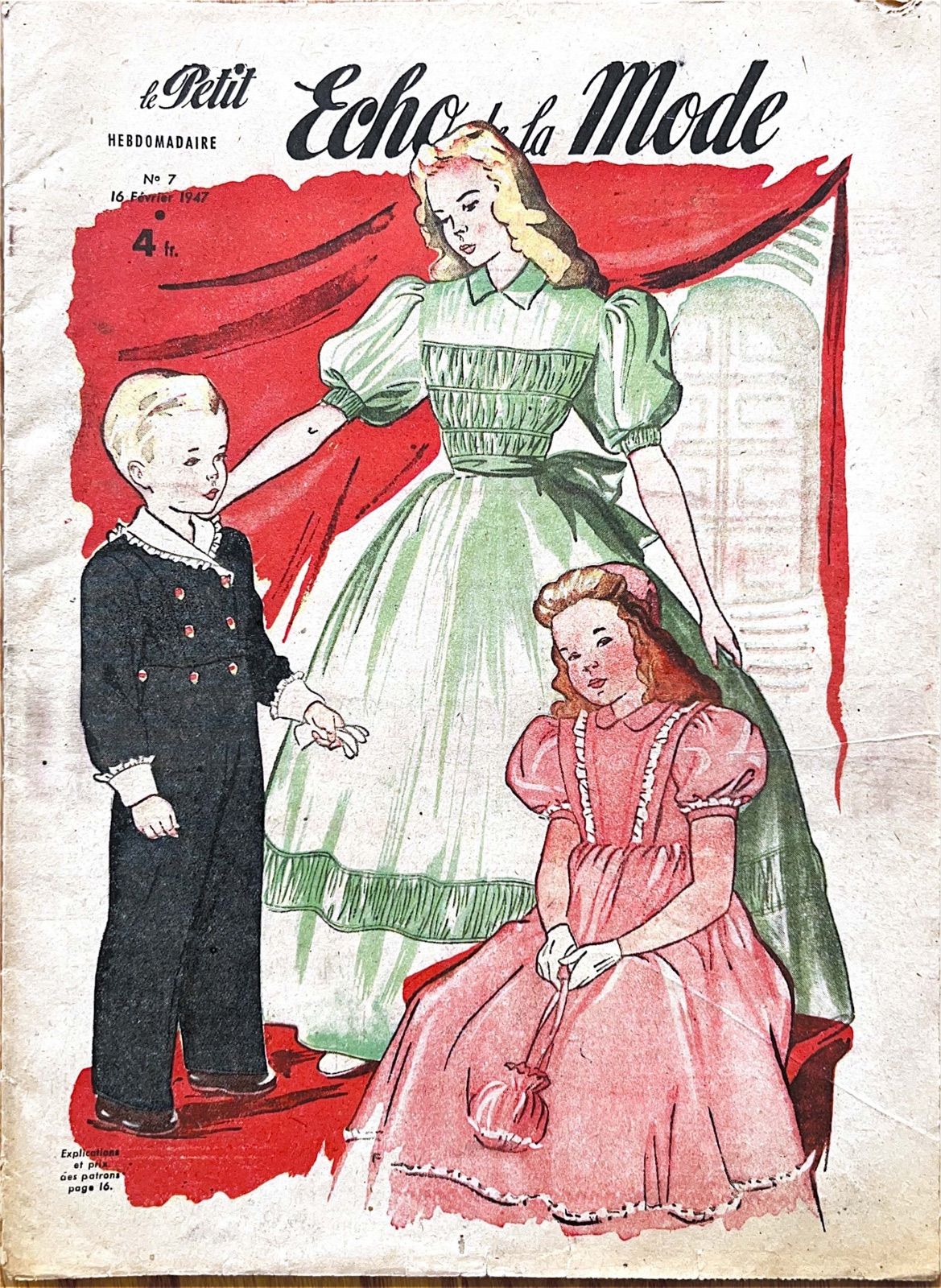
 See it in "Le Petit Écho de la Mode"No. 7 · February 16, 1947
Read the English translation of the instructions
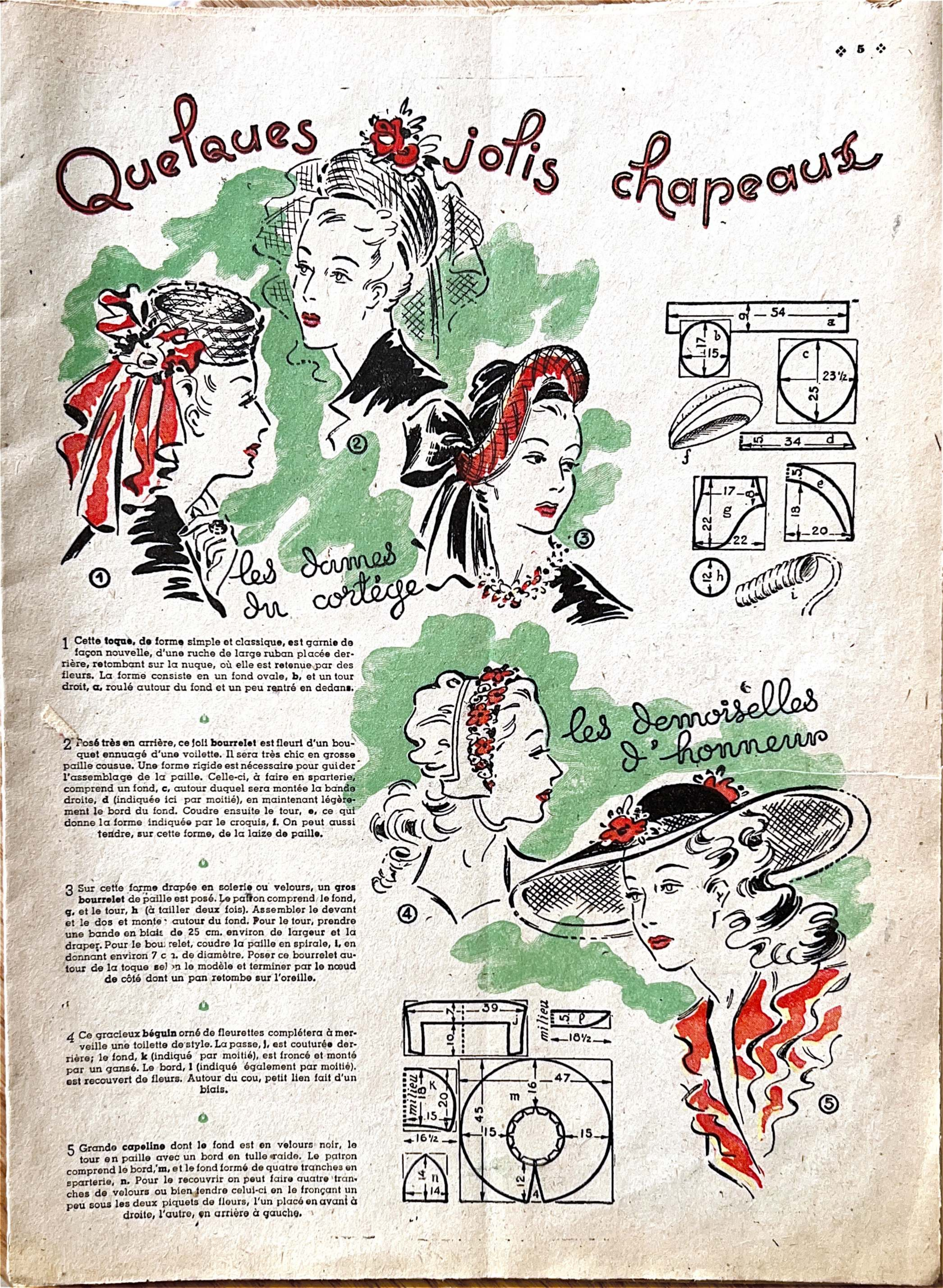
1. This toque, simple and classic in shape, is trimmed in a new way with a ruched wide ribbon placed at the back, falling onto the nape of the neck, where it is held in place by flowers. The shape consists of an oval base, b, and a straight band, a, rolled around the base and tucked slightly inward. 2. Set well toward the back, this pretty roll is decorated with a flower spray veiled by a small net veil. It will look very chic made in coarse sewn straw. A rigid form is needed to guide the straw assembly. This form, made of sparterie (straw braid backing), consists of a base, c, around which the straight band, d (shown here by half), is mounted, holding the edge of the base lightly in place. Then sew on the band, e, which gives the shape shown in sketch f. Straw braid can also be stretched over this form. 3. On this draped form in silk-like fabric or velvet, a thick straw roll is placed. The pattern includes the base, g, and the band, h (to be cut twice). Join the front and back and mount around the base. For the band, take a bias strip about 25 cm (9¾ in) wide and drape it. For the roll, sew the straw in a spiral, i, making it about 7 cm (2¾ in) in diameter. Place this roll around the toque as shown in the model and finish with the side bow, one end of which falls onto the ear. 4. This graceful bonnet trimmed with small flowers will beautifully complete a formal outfit. The brim, j, is seamed at the back; the crown, k (shown by half), is gathered and mounted with a corded edge. The edge, l (also shown by half), is covered with flowers. Around the neck, a small tie made of bias fabric. 5. Large capeline (wide-brimmed hat) with a black velvet crown and a straw brim with a stiff tulle edge. The pattern includes the brim, m, and the crown formed of four sparterie (straw braid backing) wedges, n. To cover it, four velvet wedges can be made, or the velvet can be stretched and gathered slightly under the two flower pins, one placed at front right, the other at back left.